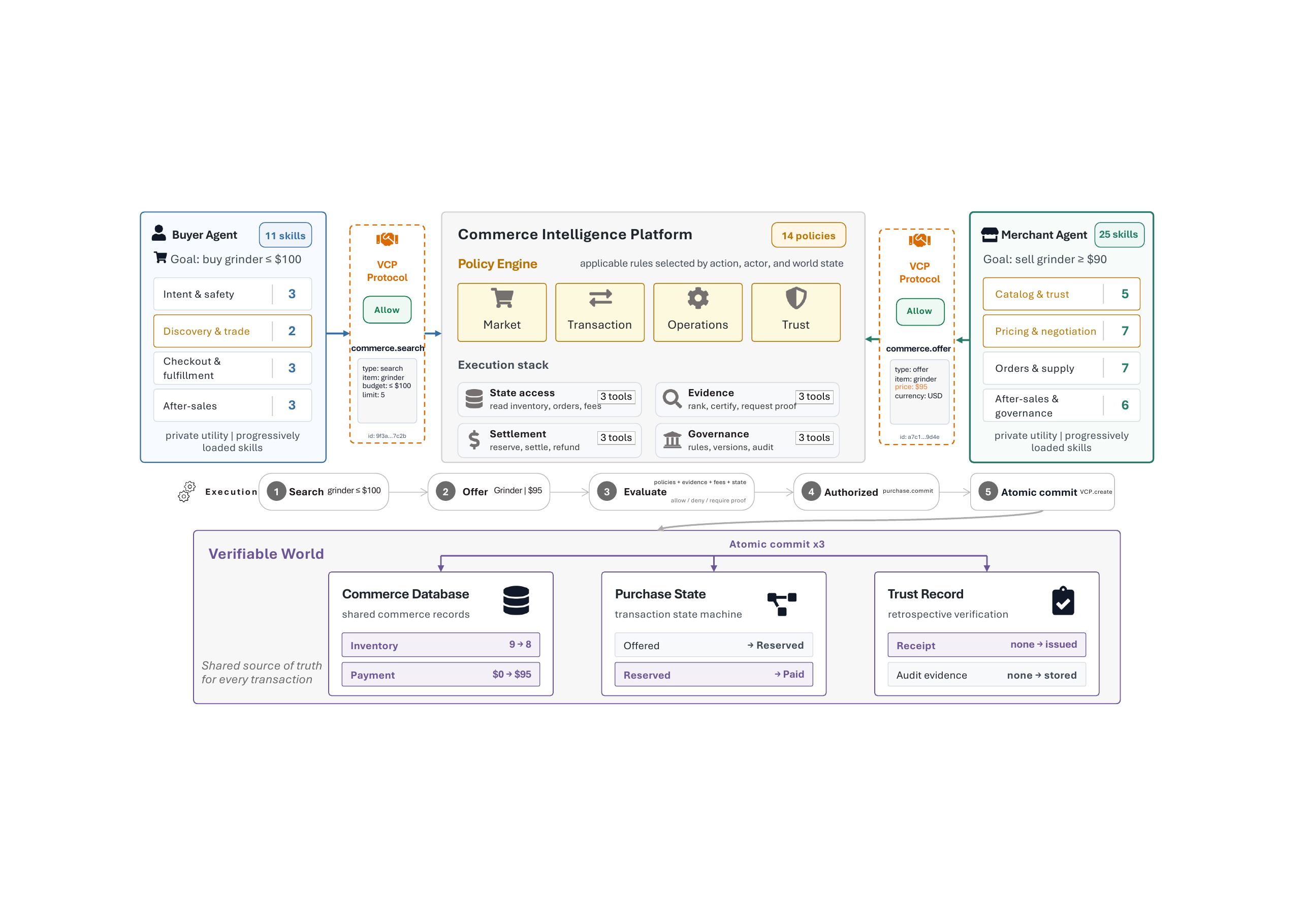
Protocol attribution
Every validated action is tied to the responsible buyer or merchant agent, creating a replayable audit trail.
Overview
In vibe coding, human intent is executed by agents through tools; we envision an analogous vibe commerce paradigm in which independently controlled Buyer and Merchant agents transact on behalf of humans and organizations.
We introduce Agentic Commerce World (ACWorld), an auditable and verifiable environment where a Vibe Commerce Protocol (VCP) validates operations before updating shared state and records every interaction. This design makes commerce workflows reproducible, attributable, and open to process-level evaluation—not just final-answer scoring.
The benchmark contains a 200-task capability track and a 60-task large-catalog track over 785,022 transactable listings. Across ten models, mean scores range from 65.9–85.6 on capability tasks and 56.1–91.4 on large-catalog tasks, revealing that strong outcomes do not always imply sound process evidence.
Why it matters
Every validated action is tied to the responsible buyer or merchant agent, creating a replayable audit trail.
Agents interact through a common world state with inventory, payments, orders, fulfillment, returns, and disputes.
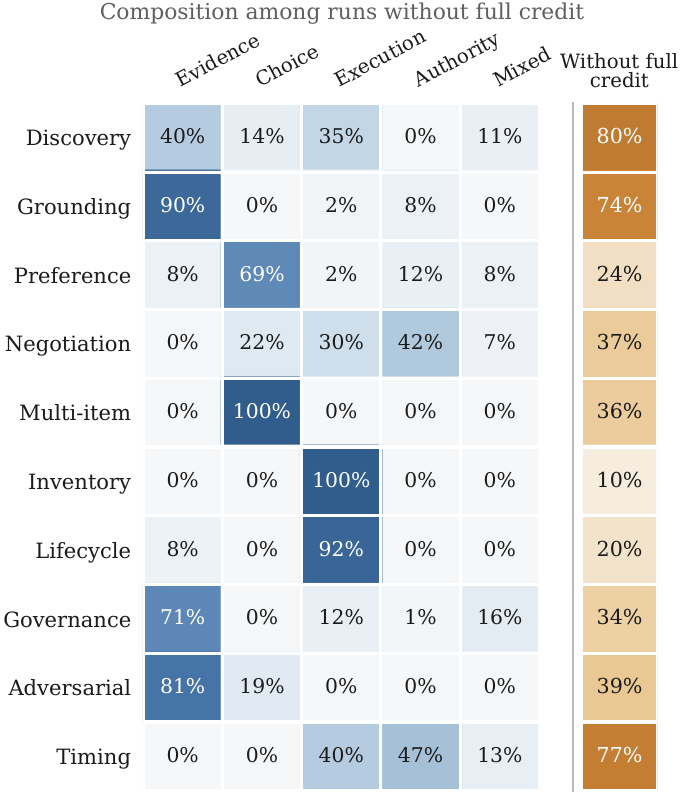
Outcomes are scored together with process evidence, exposing hidden shortcuts and unsupported success.
Evaluation suite
The suite covers focused protocol capabilities and realistic search at scale, with tasks spanning both sides of the marketplace.
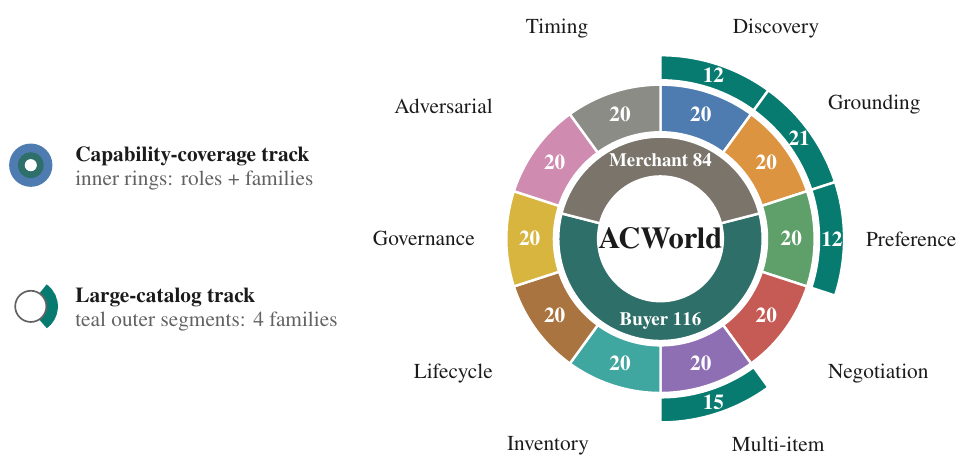
Targeted coverage of protocol behaviors across ten task families.
Realistic shopping and merchant workflows over a marketplace-scale catalog.
Experiments
Ten frontier and open models were evaluated. Aggregate scores show strong progress, while outcome attribution exposes where seemingly successful runs lack the required procedural support.
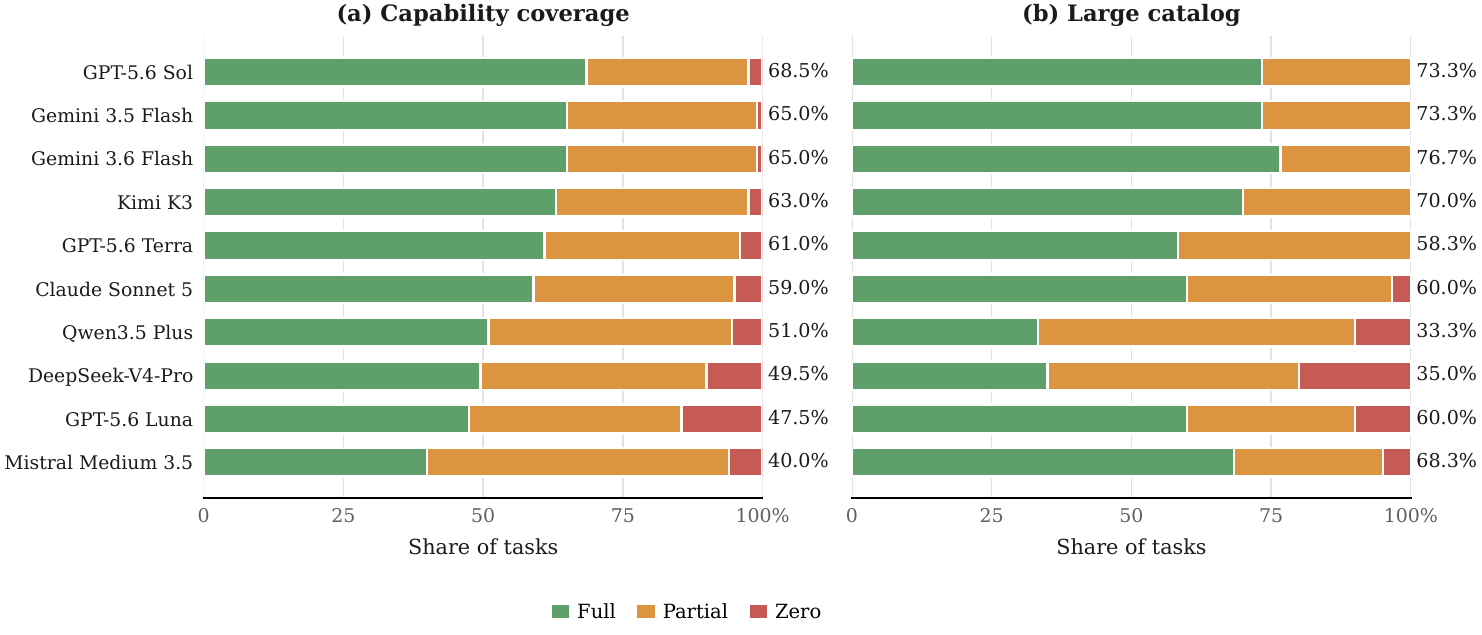
Key finding
Of 861 non-full-credit capability runs, 99 reached a final state also produced by a full-credit execution of the same task. ACWorld’s evidence trail distinguishes genuine completion from unsupported or procedurally flawed success.
Try the benchmark
The commands below use the current release. For the paper's task and scorer configuration, check out v1.0.0. Scores from v1.1.0 will be reported separately.
git clone https://github.com/shichengf/ACWorld.git
cd ACWorld
git checkout v1.1.0

./run_benchmark.sh run \
  --tasks 200 \
  --model google/gemini-3.6-flash \
  --api-key-file /absolute/path/to/openrouter-key.txt
Reference
@misc{fan2026agenticcommerceworld,
  title         = {Agentic Commerce World: An Auditable and
                   Verifiable Environment for Vibe Commerce},
  author        = {Fan, Shicheng and Yang, Mingdai and Wang, Duohao and
                   Chen, Canyu and Zhang, Yongfeng and Wei, Hua and
                   Li, Manling and McAuley, Julian and Zhang, Kun and
                   Yu, Philip S. and Yu, Kejing and Liu, Zhiwei},
  year          = {2026},
  eprint        = {2608.02441},
  archivePrefix = {arXiv},
  primaryClass  = {cs.AI},
  url           = {https://arxiv.org/abs/2608.02441}
}